

- Setup: how to model your warehouse data and configure your project for best results.
- Querying: how filters, charts, sharing, and scheduling work once you’re set up.
Timezone Setup
tl;dr: store timestamps as timezone-aware types, use
DATE for calendar values, and set your project timezone to the zone you report in.Timezone conversion
Lightdash converts the timezones of your data from their source timezone to a report timezone:- Source timezone is the timezone of the raw data. It is defined in your warehouse, data types, modelling, and connection settings.
- Report timezone is the timezone you want to see in your results. It is defined by the project/user preferences, and specific chart/dashboard configuration.
Pick the right column types in your warehouse
Store your event timestamps as timezone-aware types. They unambiguously identify a moment in time and require no extra configuration. If you choose a naive timestamp it’s timezone will be assumed to be in UTC unless you have configured the default data timezone.| ✅ Use this (timezone-aware) | ❌ Avoid this (timezone naive) | |
|---|---|---|
| Warehouse type | TIMESTAMPTZ, TIMESTAMP WITH TIME ZONE, TIMESTAMP_LTZ, TIMESTAMP_TZ | TIMESTAMP_NTZ, TIMESTAMP WITHOUT TIME ZONE,DATETIME |
| Timezone | Timezone baked into each timestamp | Timezone assumed from default data timezone (default UTC) |
Use DATE only for calendar values
If a column represents a calendar date rather than a moment in time, store it as DATE. Lightdash treats DATE columns as fixed calendar dates and never shifts them: 2024-03-15 stays 2024-03-15 regardless of the project timezone.
Use DATE for values like:
- A user’s date of birth
- A subscription start date
- An anniversary
- A fiscal-period boundary
DATE is not what you want for event timestamps.
Configure your connection
For timestamps without timezones (naive timestamps), we assume they follow the default data timezone. You can configure this in your warehouse connection settings: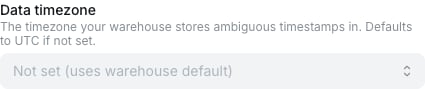
- If all your naive timestamps are in UTC (very common, since most ELT pipelines normalize to UTC): leave it as UTC.
- If your naive timestamps are in a single non-UTC zone (e.g. an on-prem system that logs in local time): set the data timezone to that zone. Lightdash will interpret naive values as being in that zone.
- If your naive timestamps have a mix of timezones - we currently don’t support overriding the timezone on a per-column level. Reach out to the team if you have a use case. If it’s an option, consider re-modelling your data in a timezone-aware type.
Configure your project timezone
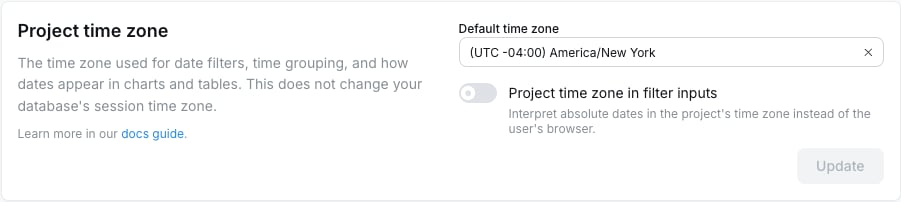
In Project settings → Timezone, pick the zone you want reports to use. Lightdash will convert all reports from the raw data timezone into the project timezone. This is the zone in which:- Timestamps are displayed in tables, on chart axes, and in exports.
- “Today” and “yesterday” are computed in relative date filters.
- Data is bucketed in a per-day grouped bar chart.
Opt a column out of timezone conversion
Most columns don’t need annotations. The main exception is system or audit columns where you want the raw stored value displayed, with no shift to the project timezone:- dbt v1.9 and earlier
- dbt v1.10+ and Fusion
- Lightdash YAML
DATE columns need no annotation. If you declare a column as type: date, Lightdash treats it as a calendar value with no timezone applied, and renders it as-is.
Naming conventions
Lightdash doesn’t enforce naming, but consistent suffixes make a model easier to read:..._atfor timezone-aware timestamps (e.g.,created_at,purchased_at)...._datefor calendarDATEcolumns (e.g.,signup_date,effective_date)...._at_utcfor columns you’ve explicitly markedconvert_timezone: false.
Calendar dates vs timestamps: what shifts
Whether a column moves with the chart’s timezone depends on its type, not its name:TIMESTAMPcolumns identify a moment in time, so they shift into the resolved timezone.DATEcolumns are calendar values with no clock, so they never shift.2024-03-15stays2024-03-15for every viewer.
| Dimension | Indicator | What it means |
|---|---|---|
| Timestamp | Default icon, “Timestamp, shifts with the chart’s timezone” | Renders in the resolved timezone. |
| Day-or-coarser interval of a timestamp | Default icon, “Calendar date, shifts with the chart’s timezone” | Bucket boundaries move with the timezone. |
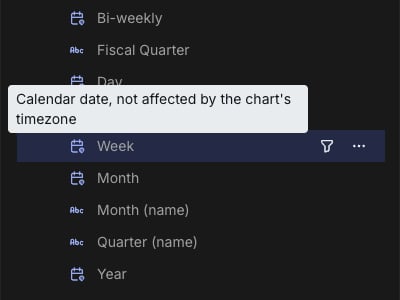
DATE column | Calendar pin, “Calendar date, not affected by the chart’s timezone” | Never shifts. |
Timestamp with convert_timezone: false | Clock pin, “Timestamp shown as stored, not affected by the chart’s timezone” | Shown exactly as stored. |
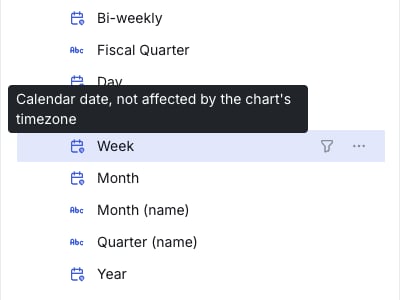
Daily use
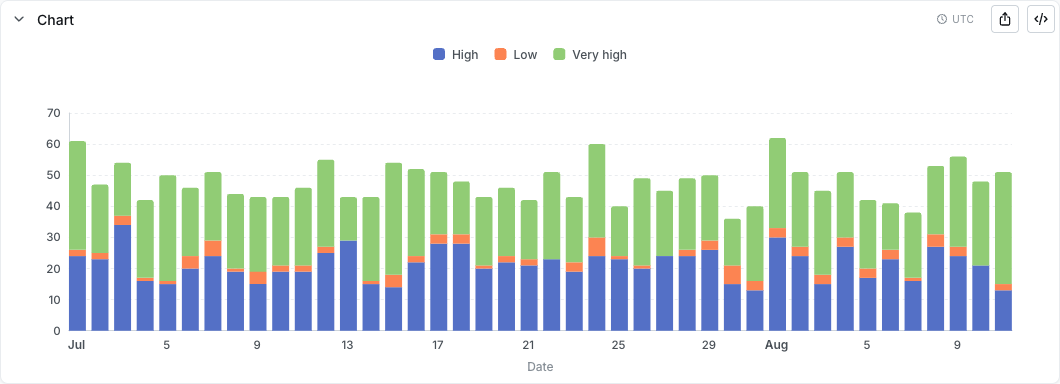
The chart timezone badge
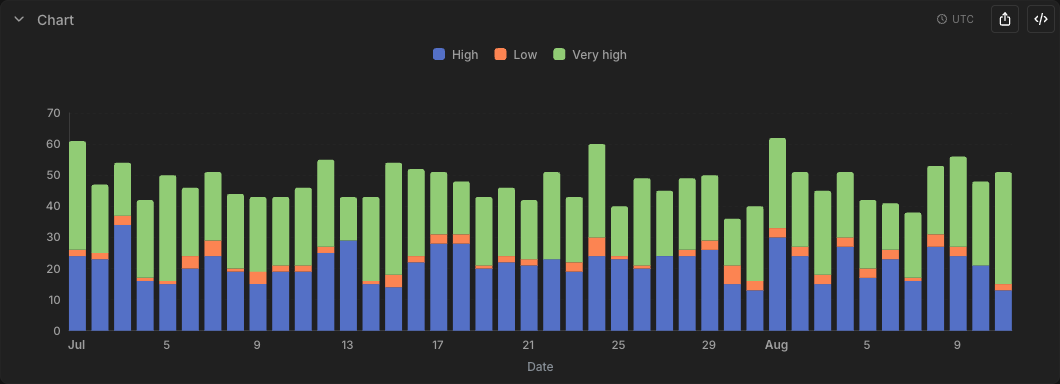
Every chart in Explore and on dashboards shows a small badge with its resolved timezone, for example(UTC +01:00) Europe/London. It’s the zone the chart’s filters, buckets, and values use, resolved by the rules in below.
Report timezone resolution
A chart’s own timezone setting decides what zone it uses, unless an embed overrides it. The zone it ends up using is its resolved timezone, the term used throughout this guide. From highest priority:- A direct embed’s
timezoneURL parameter (on iframe or shareable-URL embeds only, see Embedded dashboards). This outranks everything. - Otherwise, the chart’s timezone setting applies:
- Project timezone (the default): the project’s timezone, for every viewer.
- User timezone: the viewer’s profile timezone, or the project timezone if they haven’t set one.
- A specific timezone: that exact zone, the same for everyone.
Choosing a chart timezone
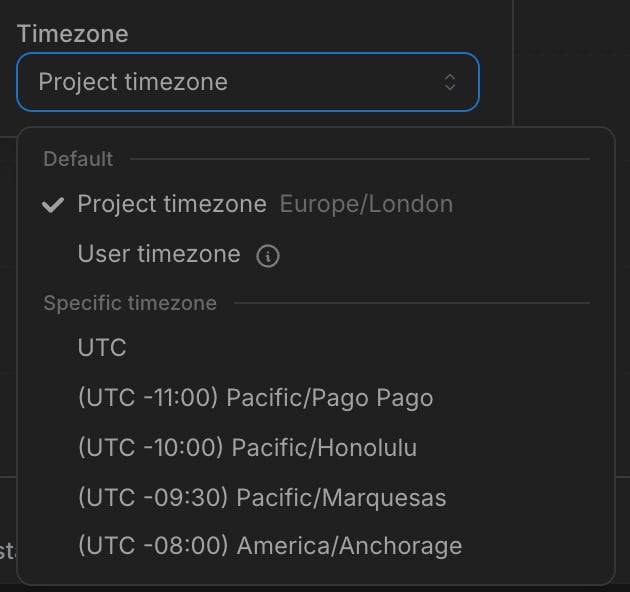
Open the Run query settings (the dropdown next to the Run query button in Explore) and use the Timezone picker to choose how the chart resolves its zone. There are three options: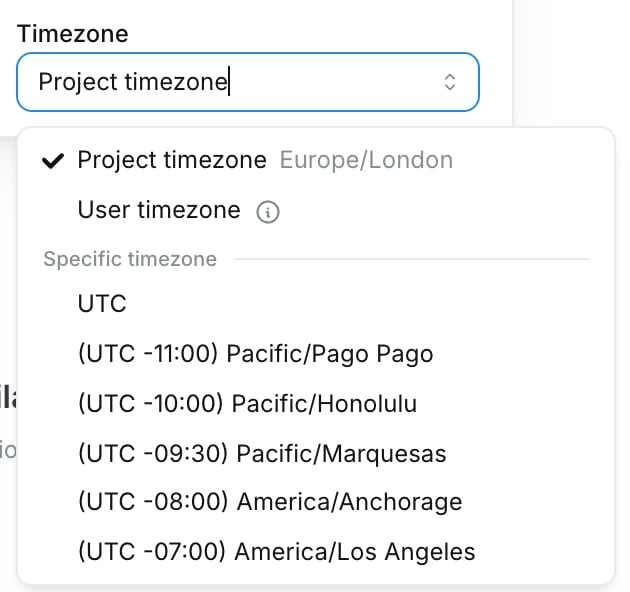
| Option | What viewers see | When to use |
|---|---|---|
| Project timezone*(default)* | Everyone sees the project’s timezone. If the project timezone changes later, the chart follows. | Shared reports and dashboards where the numbers should mean the same thing for everyone. |
| User timezone | Each viewer sees their own profile timezone, or the project timezone if they haven’t set one. | Personal exploration, or internal dashboards where each viewer should see their own day boundaries. |
| A specific timezone | A fixed zone (e.g. America/New_York), the same for everyone, frozen regardless of project or viewer. | A chart that must always report in one zone, such as a regional report. |
How filters work
Relative date filters
Relative filters like “yesterday,” “last 7 days,” and “this month” are computed in the chart’s resolved timezone. On a chart resolved to America/New_York, “yesterday” is the day that just ended in New York.Absolute date filters
Absolute date filters (a specific date or range) are unambiguous.2024-03-15 is 2024-03-15, and behaves the same for every viewer.
Filters that include a time of day (for example “events after 9am on March 15”) are more subtle. By default the datetime picker works in each viewer’s browser timezone, so the same typed value can resolve to a different moment for different viewers.
To keep these filters consistent, a project admin can turn on Project time zone in filter inputs in Project settings → Timezone. Set a project timezone first; the toggle is disabled until one is set.


- The picker shows and interprets values in the project timezone, so the same typed value means the same moment for everyone.
- A line under the picker shows the equivalent local time, and a label shows the active timezone.
- Existing saved filters aren’t rewritten. They keep the same moment, just shown in the new zone.


Cell-click filters
Clicking a bar or cell filters on the value as shown, not the underlying instant. Click “March 2024” and you get March 2024 in the chart’s timezone, exactly what you saw.Day-grouped vs hour-grouped charts
Day and hour groupings respond to timezone differently, which changes how charts look across viewers.Day-or-coarser grouping
A chart grouped by day, week, month, quarter, or year buckets data by calendar boundaries, so when the resolved timezone changes (for example on a User-timezone chart) those boundaries move and the same events can land in different bars. Two viewers can then see different numbers on the same daily chart. This is correct, since each sees their own calendar, but it can be surprising. See Choosing a chart timezone to control it.Sub-day grouping
A chart grouped by hour, minute, or smaller buckets data by instants. The boundaries are the same for every viewer; only the labels shift (your “9am EDT” is someone else’s “2pm BST,” but the bar contains the same events). Sub-day grouping is consistent across viewers. The exception is half-hour and 45-minute offset zones (India, Nepal, parts of Australia), where bucket boundaries don’t align with whole-hour zones.MIN/MAX date and timestamp metrics
Amin or max metric renders by the type of the column it aggregates, following the same calendar-vs-instant rule as dimensions:
DATEcolumn (or a day-or-coarser date interval like_month): a plain calendar date at that grain, never shifted.TIMESTAMPcolumn: shifted into the resolved timezone, like a timestamp dimension.
Custom MIN/MAX metrics built in the Explore view pick this up automatically. Metrics defined in dbt or Lightdash YAML need a project recompile (Refresh dbt or
lightdash deploy) before the new formatting applies.Daylight-saving transitions
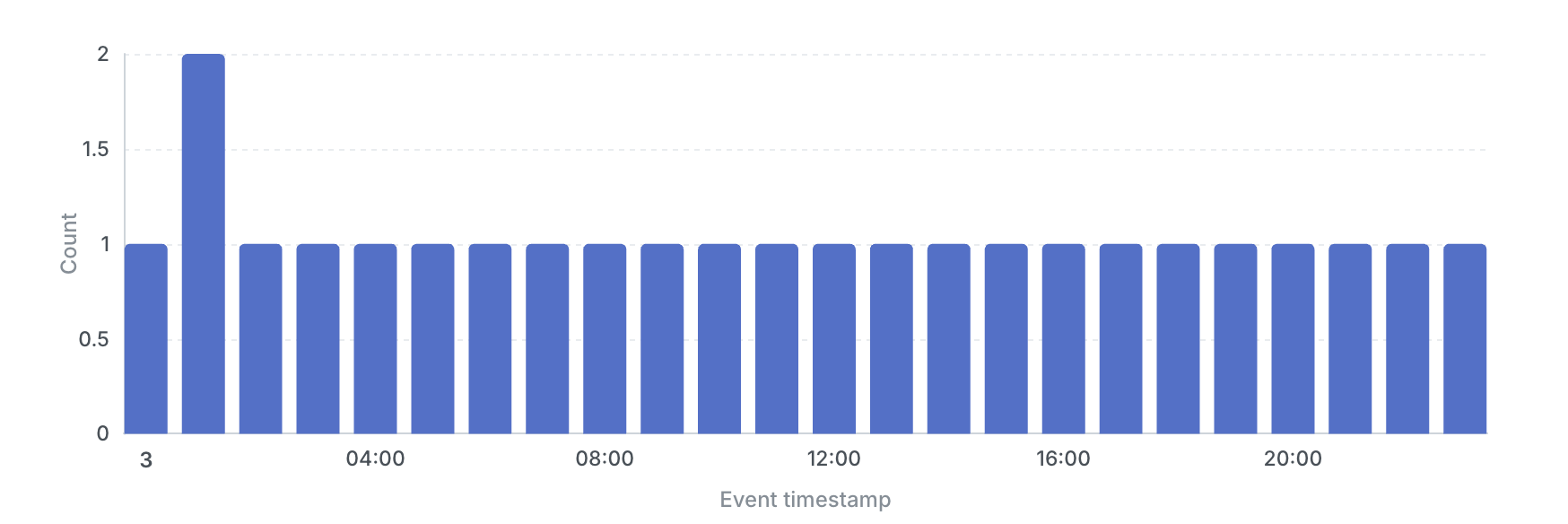
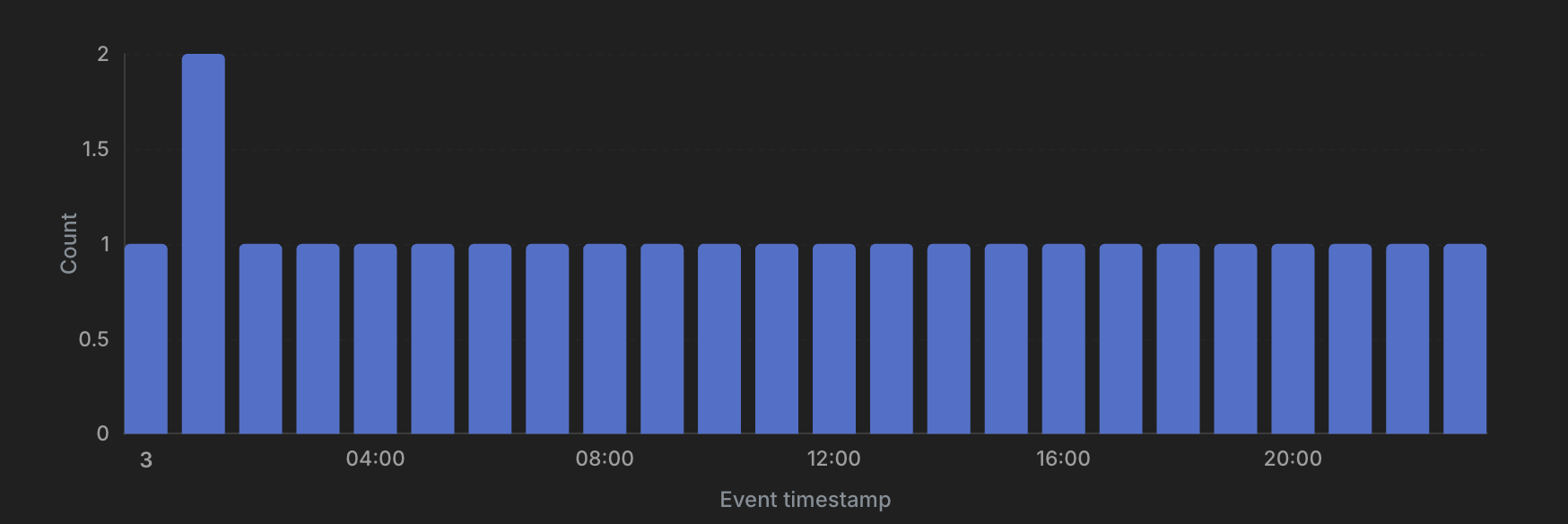
Lightdash buckets data by local time in the resolved timezone, so daylight-saving transitions show up in your charts.- On a daily chart, the fall-back day spans 25 hours and the spring-forward day spans 23. Each bar still counts exactly the events in that calendar day, and drilling in returns them all.
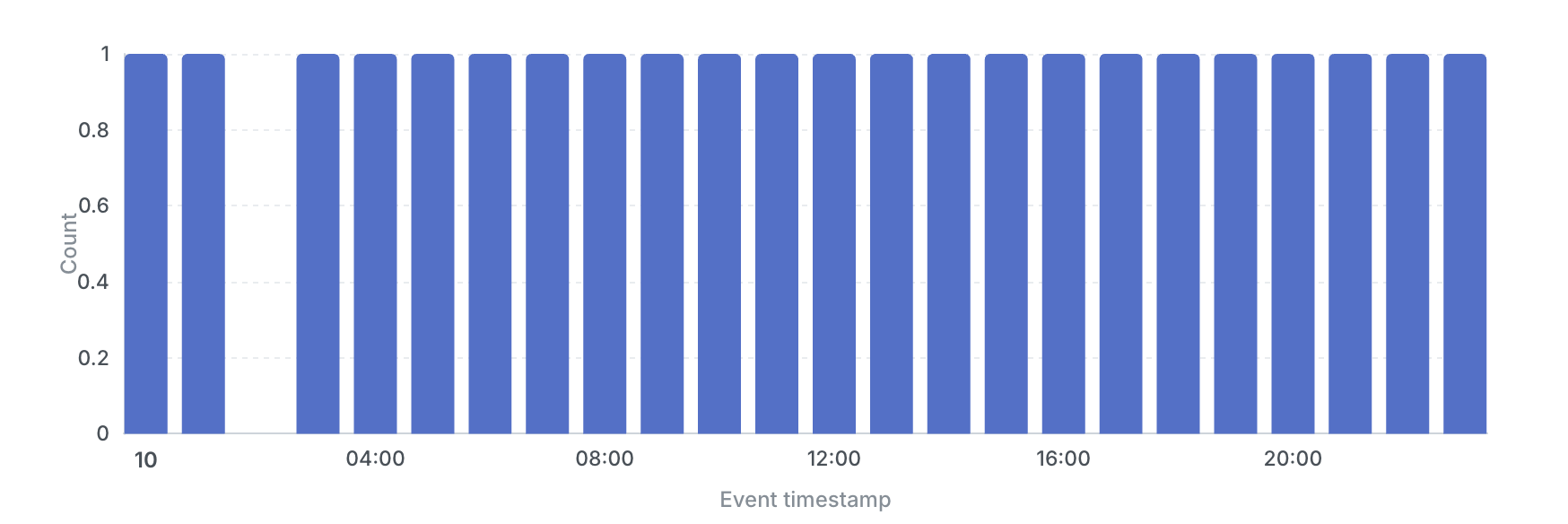
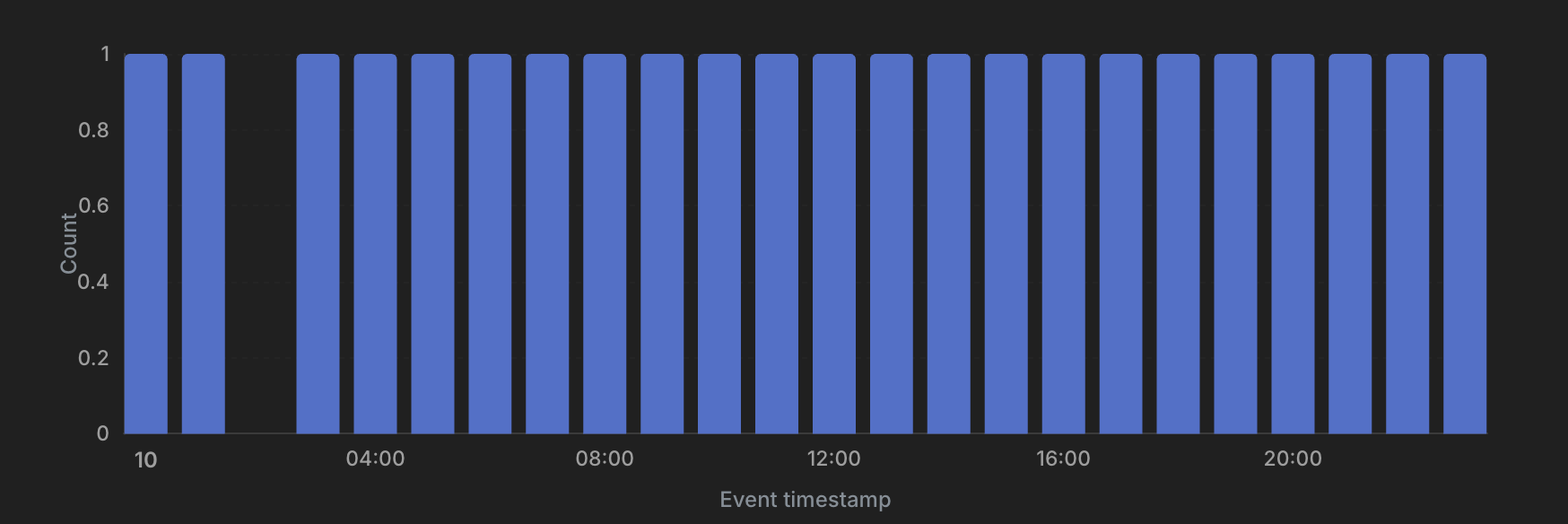
- On an hourly chart, the two 1 AM hours on the fall-back day merge into a single bar with double the count, and the missing 2 AM hour on the spring-forward day simply has no bar.
Your profile timezone
In your Profile settings, you can set a Default timezone. It affects only charts set to User timezone, which resolve to your profile zone when you view them. It does not affect:- Charts set to Project timezone or to a specific timezone.
- Embedded dashboards (an embed has no viewer profile to read).
Dashboards
Every chart on a dashboard keeps its own timezone setting, so one dashboard can mix Project-timezone charts (same for everyone) with User-timezone charts (per viewer). Each chart’s badge shows the zone it resolved to. A dashboard date filter sends the same value to every chart, but each chart reads it in its own zone. So a “last 7 days” filter can cover a different window on a Project-timezone chart than on the User-timezone chart next to it.Scheduled deliveries
Scheduled reports have two independent timezone settings:| Setting | Controls | Example |
|---|---|---|
| Delivery time | When the report fires | ”Send at 9am every Monday” uses the delivery timezone |
| Chart data | What “yesterday” / “last week” mean in the report | ”Last 7 days” uses each chart’s resolved timezone |
- Delivery time in the recipient’s working timezone (so the report arrives at a useful hour).
- Chart data on the project timezone (so the numbers are consistent and explicable).
Embedded dashboards
An embedded dashboard has no signed-in viewer, so there’s no profile timezone to read. Its zone resolves one of two ways:- A
timezoneURL parameter sets one zone for the whole session and overrides every chart. Available on direct iframe and shareable-URL embeds only, not the React SDK. See embedding URL parameters. - Otherwise, each chart uses its own setting: the project timezone, or a specific zone if one was pinned. A User-timezone chart falls back to the project, since there’s no profile to read.
When things go wrong
Common symptoms and their usual causes. When something looks off, the chart’s badge and the connection’s data-timezone preview show exactly what Lightdash is using.Two viewers see different numbers on the same chart
Two viewers see different numbers on the same chart
This usually means the chart is on User timezone, so each viewer gets their own day boundaries. Check the chart’s badge and switch it to Project timezone if everyone should match.
A daily chart shows a partial 'today' bar the author didn't see
A daily chart shows a partial 'today' bar the author didn't see
All timestamps are off by an hour or more
All timestamps are off by an hour or more
The data timezone on the connection is probably incorrect. Open Project settings → Connection → Data timezone and use Preview to confirm how values are read.
A CSV export shows different times than the Lightdash UI
A CSV export shows different times than the Lightdash UI
The export may have run with a different chart timezone. Re-export from a chart set to the zone you want.
A 'yesterday' filter returns no data, but yesterday clearly has data
A 'yesterday' filter returns no data, but yesterday clearly has data
Your project timezone might be set to a zone where “yesterday” hasn’t started yet. Check it under Project settings → Timezone.
An hourly chart looks like it skipped or doubled an hour
An hourly chart looks like it skipped or doubled an hour
This is likely a daylight-saving transition in the period shown. Switch the chart to UTC to confirm it’s a DST artifact, not a data problem.
Example: one row, four configurations
Imagine one row in yourorders table:
| Column | Type | Stored value |
|---|---|---|
order_date | DATE | 2026-05-19 |
order_created_at | TIMESTAMP (UTC) | 2026-05-19 02:00:00 UTC |
| Configuration | order_created_at shows | Grouped by day | order_date shows | Same for every viewer? |
|---|---|---|---|---|
Project timezone UTC | 2026-05-19 02:00 | 2026-05-19 | 2026-05-19 | Yes |
Project timezone America/New_York | 2026-05-18 22:00 | 2026-05-18 | 2026-05-19 | Yes |
One chart pinned to Asia/Tokyo (project stays NY) | 2026-05-19 11:00 | 2026-05-19 | 2026-05-19 | Yes on that chart, but the dashboard now mixes zones |
| Chart set to User timezone | the viewer’s local time | the viewer’s local day | 2026-05-19 | No, each viewer sees their own day |
The pattern. Timestamp rendering and bucketing shift with the resolved zone. DATE values never shift. But anything derived from “now” (relative filters) always uses the resolved zone, regardless of column type.